· 11 min read
I asked my AI checker to judge values, not labels. Here’s what held.
Part 2 of TwoPass: the same tool on a harder job, pulling fields out of government forms
Contents
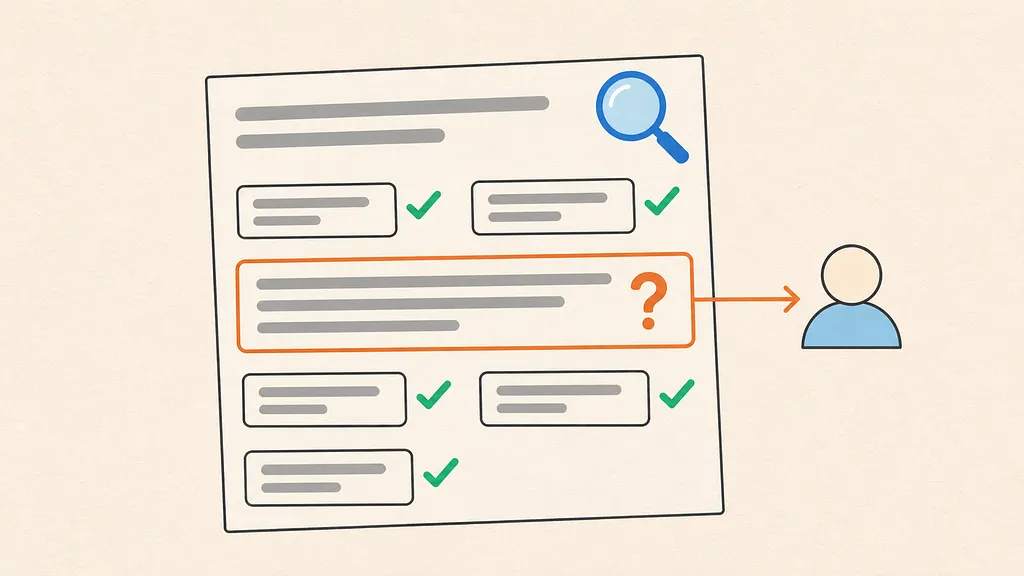
After part 1, a reader left a comment that ended with a question: “Are you planning to test TwoPass on extraction work too, where the answer is a value rather than a category?” Their team had learned the hard way, building memory for coding agents, when a parser read every field one column off. Their conclusion: “a confident wrong number is worse than a blank.”
That line stayed with me, because it names the failure that matters. A blank is annoying. A confident wrong value goes straight into someone’s spreadsheet.
So I measured it. On 3,000 fields from 500 public government forms, TwoPass accepted 81.5% of them on its own, and 95.5% of those were right. That’s 36 confident wrong values per 1,000 fields. Claude Opus 5.5 doing the whole job alone had 83, at nine times the cost.
The rest of this piece is what that number hides, including the two parts that didn’t work.
Why extraction is harder for this design
TwoPass puts a small, cheap decision model in charge as a checker. In part 1 the checker could do something clever: the answer was one of 77 labels, so it could simply pick one itself, and most of the time it was right. A writing model was only called when the checker wasn’t sure.
Extraction takes that away. The answer isn’t on a list. It’s “14 March 1983”, or “Ministry of Tourism of Jamaica”, or nothing, because the form doesn’t have that field. A decision model can’t write that. It can only look at a value someone else wrote and say whether it’s right.
So the pipeline becomes:
- A cheap model (Claude Haiku 5.5) reads each document once and fills in all six fields, using “not in the document” where a field is missing.
- The checker gets six questions per document, one per field: the writer says the date of signature is “14 March 1983”. Is that right? Supported, not supported, or can’t tell.
- Fields the checker is confident about are accepted. If any field in a document isn’t, a stronger model (Claude Sonnet 5.5) reads the document again, and the checker judges its values.
- Whatever is still doubtful goes to a person, with the tool’s best value filled in.
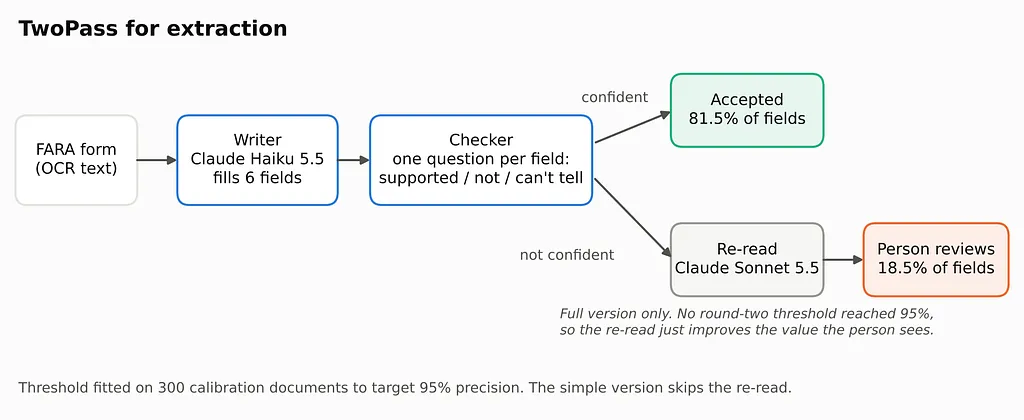
Figure 1. The simple version is writer → checker → person. The full version adds the Sonnet re-read.
If that shape looks familiar, it should. FrugalGPT (Chen, Zaharia and Zou) built the same kind of cascade: a cheap model answers, a scorer rates the answer, and anything below a threshold moves up. The differences here are that the scorer is an off-the-shelf decision model rather than one trained for the task, it judges each field rather than each query, and the threshold is set for a precision target rather than a budget.
The question I wanted answered: does the confidence threshold, fitted on held-out examples to give 95% precision, still give 95% precision when the checker can’t propose anything?
The test
The documents are Foreign Agents Registration Act filings from the US Department of Justice. Under the 1938 Act, people and firms acting in the US for foreign governments, parties or companies register with DOJ, and their filings are public records. They come from VRDU, a research benchmark from Google Research (Wang, Zhou, Wei, Lee and Tata, KDD 2023), with the text already read off the scans by a commercial OCR engine.
Six fields per form: the date of signature, the registration number, the registrant, the foreign principal, and the signer’s name and title. About a quarter of all field slots are genuinely empty, and the gaps cluster. Across the full VRDU set, the foreign principal is filled on only about 59% of forms and the signer title on about 29%. Amendments, for example, have no dedicated foreign-principal box. That makes “not in the document” a right answer about one time in four, which is exactly where a model that always fills in something goes wrong.
I split the documents three ways: 30 for building, 300 for fitting the threshold, and 500 for the published numbers. The threshold never saw a test document. This is my own split, not VRDU’s official few-shot splits, so these numbers aren’t comparable with the paper’s baselines.
The results
- Claude Opus 5.5 on every field: accepts 100%, 91.7% right, 249 confident wrong of 3,000, none to a person, $0.99 per 1,000 fields.
- Claude Haiku 5.5 alone, no checker: accepts 100%, 86.8% right, 396 confident wrong, none to a person, $0.03.
- TwoPass, simple (writer, checker, person): accepts 81.5%, 95.5% right, 109 confident wrong, 18.5% to a person, $0.11.
- TwoPass, full (with the stronger re-read): accepts 81.5%, 95.5% right, 109 confident wrong, 18.5% to a person, $0.49.
Costs at Anthropic and Cloudflare list prices, November 2026, with batch discounts and prompt caching on for every configuration, the Opus baseline included.
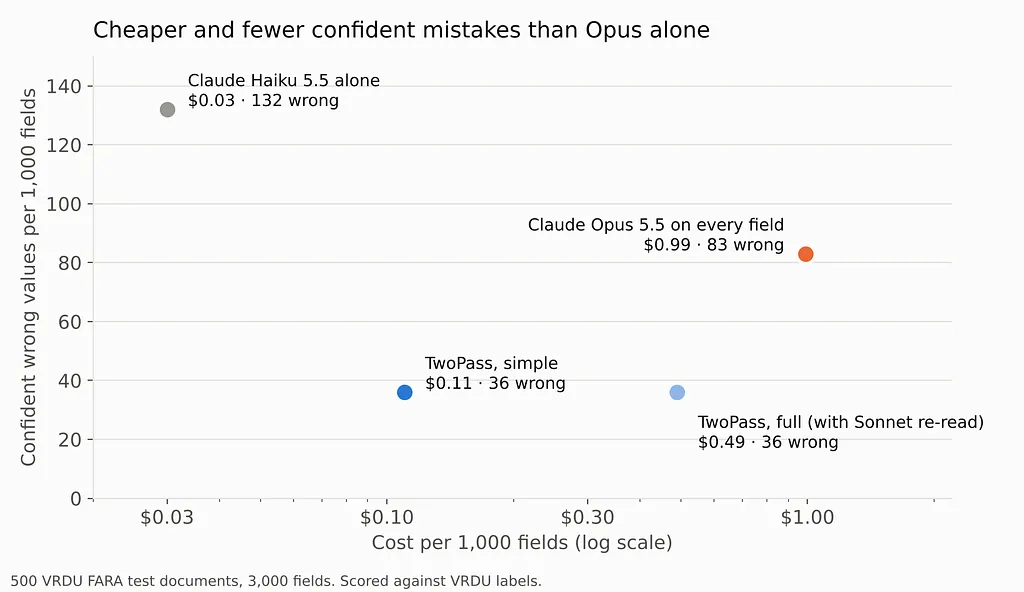
Figure 2. Lower and further left is better.
The threshold held. I asked for 95% and got 95.5% on documents it had never seen. With about 2,450 accepted fields, the 95% confidence interval runs from roughly 94.6% to 96.3%, so the honest reading is “on target”, not “beat the target”. I also tried two other checkers on the same values, Jev and Luna, each with its own fitted threshold. They landed at 95.3% and 95.8%. Those three are a statistical tie, not a ranking. Three different models, the same promise kept.
Compared with part 1, the checker vouches for less. In part 1 it accepted 97.5% of messages, and here it accepts 81.5% of fields. One field in five goes to a person. That’s the price of the checker no longer being able to answer for itself.
Blanks and values behave differently
Split by whether the form actually has the field, the picture changes:
- The form has a value: 90.4% accepted, 95.8% of those right.
- The form has no such field: 52.3% accepted, 94.2% of those right.
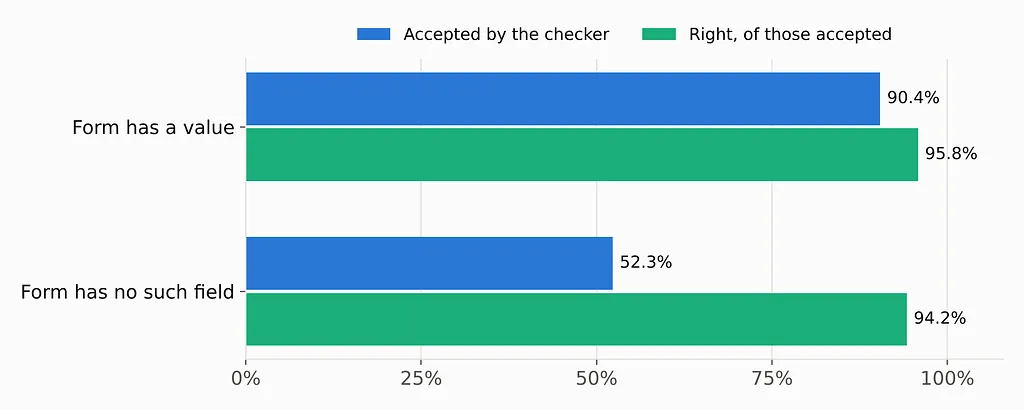
Figure 3. The checker is much less willing to vouch for a blank.
The checker is much less willing to vouch for “this field isn’t here”, and when it does, it’s slightly less often right. That seems fair. Confirming that a value appears in a document is a matter of finding it. Confirming that something is absent means being sure you didn’t miss it.
By field, the registration number is almost perfect: 90% accepted, 99.8% right. It’s a short number in a fixed box. Signer titles are 98.6% right. Dates are 95.3%.
What didn’t hold
One field missed the target, and not by a little: the foreign principal, at 87% precision. Even the top of its confidence interval is around 90%.
On these forms, the foreign principal is a free-text box. Sometimes it holds one name, sometimes a list, sometimes “See attached list”. The same name often appears elsewhere on the form too, in a paragraph about the work done, in an amendment’s purpose line, or on a continuation page. The writer would find a plausible name somewhere in the document, and the checker, asked whether that name is the foreign principal, would agree. It is in the document. It just isn’t the answer to that box, or it’s half of it.
This is the failure the reader warned about, in its purest form: a value that looks right, is grounded in the text, and is wrong. Extraction research has a name for it. UNIKIE-BENCH calls these field interpretation errors: the model finds the right kind of value and puts it in the wrong field. The grounding checkers I’d naturally reach for, such as MiniCheck and AlignScore, ask whether a claim is supported by the document. None of the benchmarks I found for them measures whether a supported value sits in the right field. A checker that only asks “is this supported?” is weakest exactly where a value is supported but misplaced. Grounded is not the same as correctly placed.
The second thing that didn’t hold was the stronger re-read. When the checker rejects a field and Sonnet reads the document again, the checker has to judge Sonnet’s value. On those hard leftover fields, it couldn’t tell good from bad. On the calibration documents, no threshold gave 95% precision on round-two values. So the full pipeline accepts nothing extra. It only improves the value a person sees when they review the field: that value is right 81% of the time instead of 49%. That’s useful for the reviewer, but it costs 4.6 times as much, and it isn’t the automation I built it for.
I nearly published the opposite. My first version fitted the round-two threshold on all calibration fields, easy and hard. In a real run, round two only ever sees the hard ones. That threshold looked fine in calibration and gave 94.2% precision on test, below the target. I refitted it on the fields round one actually rejects, using calibration data only and no new model calls, and the honest answer turned out to be “never accept”. Both readings are in the repository.
The labels are wrong more often than I expected
Before believing any of this, I went through all 109 confident wrong values by hand, with the form text open next to each.
In 70 of them, the tool was right and the label was wrong or incomplete. Dates mangled by the scan (“22nd day of June 19 81” stored as the answer), labels that stop halfway through a name, or include a stray word from the form. In 20, the tool was wrong; 15 of those were the foreign principal. In 19 I couldn’t decide.
There’s a mechanical reason for this. VRDU’s annotators drew boxes on the page, and the labelling tool stored whatever text the OCR had found inside each box. So the gold answers are OCR text, scan errors included. That isn’t unusual: a NeurIPS 2021 study by Northcutt, Athalye and Mueller estimated an average of 3.3% label errors across ten widely used test sets, and showed that fixing them can change which model ranks first.
I did the same review for Opus’s 249 errors. Opus was right in 76, wrong in 86, and undecided in 87. Most of its real mistakes were blanks: it said “no date” or “no title” on forms that have one.
Confident wrong values per 1,000 fields:
- TwoPass, simple: 36 against the labels, 7 to 13 after my review.
- Opus on every field: 83 against the labels, 29 to 58 after my review.
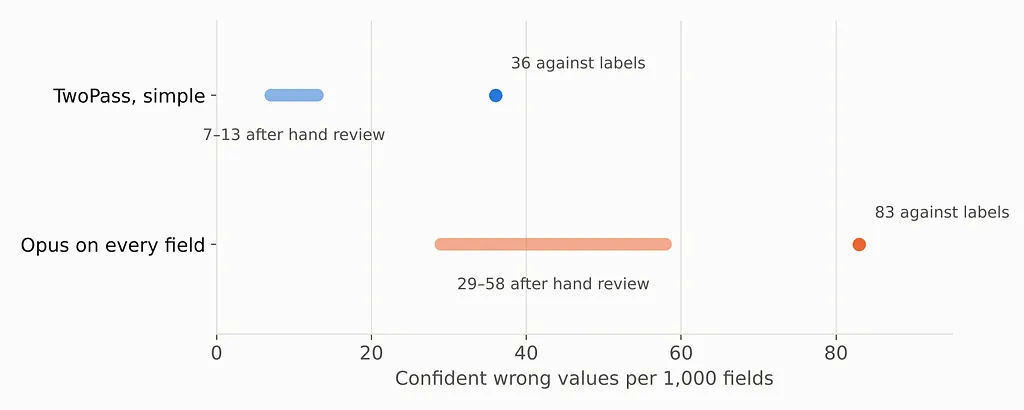
Figure 4. Dots are the scores against VRDU’s labels; bars are the range after my review.
The ranges are “undecided counted as right” and “undecided counted as wrong”. Take them with salt: one reviewer, me, and I could see which value was the tool’s. I only re-checked the fields scored wrong, not the ones scored right. The raw numbers are the ones to quote. But the review pushes in the same direction: the checker’s mistakes are rarer than the labels say, and Opus’s real mistakes are mostly blanks.
As one more check on the scoring itself, I ran VRDU’s own evaluator on the same predictions. It uses type-aware fuzzy matching (dates compared as dates, numbers normalised), so it was never going to match my scorer exactly. It agreed within a point and a half, and ranked everything the same way.
Did the simple version win again?
Yes, and more clearly than in part 1. Writer, checker, person: $0.11 per 1,000 fields, against $0.99 for Opus on everything, and fewer than half the confident wrong values. The stronger re-read adds cost without adding anything the checker can vouch for.
What you give up is coverage. One field in five goes to a person, and for some fields it’s one in three. If you need 98% precision rather than 95%, the same calibration says the checker can vouch for only 38% to 44% of fields.
And one limit is worth naming plainly. The threshold is a point estimate fitted on 300 documents. It held here, but it isn’t a guarantee. Methods like Learn then Test and conformal risk control (Angelopoulos and colleagues) pick thresholds with a formal bound on the error rate. That would be the next step if you needed a promise rather than a measurement.
Related work
ExtractConf (Nitesh Kumar, June 2026) attacks the same problem differently. It reports that token log-probabilities, the model’s self-stated confidence, and agreement between repeated samples all rate almost every extraction as trustworthy at practical thresholds. That matches older findings that models are overconfident when asked to state their confidence (Xiong et al., ICLR 2024). ExtractConf’s answer is to run two differently prompted extraction calls and train a classifier on their disagreement plus OCR, image and layout signals. On invoices it reports 99.1% accuracy at 80% coverage. That sits next to my 95.5% at 81.5%, but it’s a different dataset with a different error definition, so the numbers aren’t comparable.
TwoPass needs none of those signals. It uses an off-the-shelf decision model as an outside judge and fits one number. That costs you some coverage, but it needs no training, only a few hundred labelled documents to fit the threshold.
Closest in spirit is conformal factuality (Mohri and Hashimoto, ICML 2024): score each claim, drop the ones below a calibrated cut-off. Theirs comes with a guarantee; mine is an empirical check.
Try it
The code, the review queue and a results explorer with a precision slider are on GitHub, and everything above can be replayed from the run files without spending anything: https://github.com/Rubick1997/twopass
Part 1, where the checker sorted messages into 77 categories: https://medium.com/@vinch1910/i-built-a-tool-to-check-ais-work-the-most-useful-thing-it-says-is-i-m-not-sure-f7d656efc286
References
- Wang, Z., Zhou, Y., Wei, W., Lee, C.-Y., Tata, S. (2023). VRDU: A Benchmark for Visually-rich Document Understanding. KDD ’23. https://arxiv.org/abs/2211.15421 · Data: https://github.com/google-research-datasets/vrdu (the google-research repository releases its datasets under CC BY 4.0; the documents are public DOJ records)
- Kumar, N. (2026). Beyond Logprobs: A Multi-Signal Confidence Engine for LLM-Based Document Field Extraction. https://arxiv.org/abs/2606.24420
- Chen, L., Zaharia, M., Zou, J. (2024). FrugalGPT. TMLR. https://arxiv.org/abs/2305.05176
- Northcutt, C., Athalye, A., Mueller, J. (2021). Pervasive Label Errors in Test Sets Destabilize Machine Learning Benchmarks. NeurIPS Datasets & Benchmarks. https://arxiv.org/abs/2103.14749
- Angelopoulos, A. et al. Learn then Test. https://arxiv.org/abs/2110.01052 · Conformal Risk Control. https://arxiv.org/abs/2208.02814
- Mohri, C., Hashimoto, T. (2024). Language Models with Conformal Factuality Guarantees. ICML. https://arxiv.org/abs/2402.10978
- Tang, L., Laban, P., Durrett, G. (2024). MiniCheck. EMNLP. https://arxiv.org/abs/2404.10774
- UNIKIE-BENCH (2026), field interpretation errors. https://arxiv.org/abs/2602.07038
- Xiong, M. et al. (2024). Can LLMs Express Their Uncertainty? ICLR. https://arxiv.org/abs/2306.13063
- US DOJ, Foreign Agents Registration Act. https://www.justice.gov/nsd-fara